
Parikia
Parikia has served as the capital and main port of Paros since ancient times, sitting on the island's west coast and welcoming ferries from Piraeus, Crete and the rest of the Cyclades. Around 4,500 people live in the town year-round, in a maze of whitewashed, flat-roofed houses typical of Cycladic architecture, with a windmill marking the entrance to the harbour and a long promenade lined with cafés and small shops running south along the water.
The Kastro Built Out of a Temple
The hilltop Kastro, or castle, dates to 1260, when the Venetian ruler Marco Sanudo built it using columns and marble taken from an earlier ancient temple on the same site, a reuse of materials still visible in its surviving walls. Column drums are laid on their sides like oversized bricks and architectural blocks are stacked flat, so a single stretch of wall reads as a cross-section of the classical building it consumed. The temple is generally dated to the sixth century BC, and the hill it stood on, Agios Konstantinos, still carries two churches. Most of the circuit has gone, lost to landslip and to centuries of quarrying by townspeople, but a rounded tower and long panels of reused marble survive above the harbour.
The Church of a Hundred Doors
Nearby stands the Panagia Ekatontapiliani, a church complex begun in the 4th century and rebuilt under the Byzantine emperor Justinian I, ranked among the most important Byzantine monuments in Greece, and now also home to a small archaeological collection. Tradition attributes its founding to Saint Helen, mother of Constantine the Great, who is said to have stopped on Paros on her way to the Holy Land and vowed to raise a church if she found the True Cross; the ground beneath it had previously held an ancient gymnasium. The name means "of the hundred doors," and local legend counts 99 visible openings plus a hundredth that will appear only when Hagia Sophia in Constantinople returns to Orthodox worship. Between 1959 and 1966 the archaeologist Anastasios Orlandos stripped away later additions to restore the building to its sixth-century form, and the complex retains an early baptistery with a cruciform font.
Marble, Museums and the Ancient City
Behind the church, the Archaeological Museum of Paros holds part of the Parian Chronicle, a marble table of Greek history running down to 264/263 BC; the larger surviving section has been in the Ashmolean Museum in Oxford since the seventeenth century, and a further fragment covering the years 336/35 to 299/98 BC was found on Paros in 1897. The island's ancient wealth came from stone. The translucent white lychnites quarried in underground galleries at Marathi from around 700 BC was the preferred marble of Greek sculptors, cut by lamplight deep inside the hillside and prized because light passes several centimetres into its surface. Parikia sits directly on top of the ancient city as well: an extensive cemetery beside the port, excavated from 1983, was in use from the 8th century BC into the Hellenistic period and produced a late Geometric mass burial without parallel in the Aegean, while the Delion, a sanctuary of Apollo and Artemis, occupies the hill north of town, sited so that Delos is visible from it. An Asklepieion, a healing sanctuary of the god of medicine, was traced by German archaeologists on the hill of Agia Anna to the south-west.
Harbour, Beaches and Getting Around
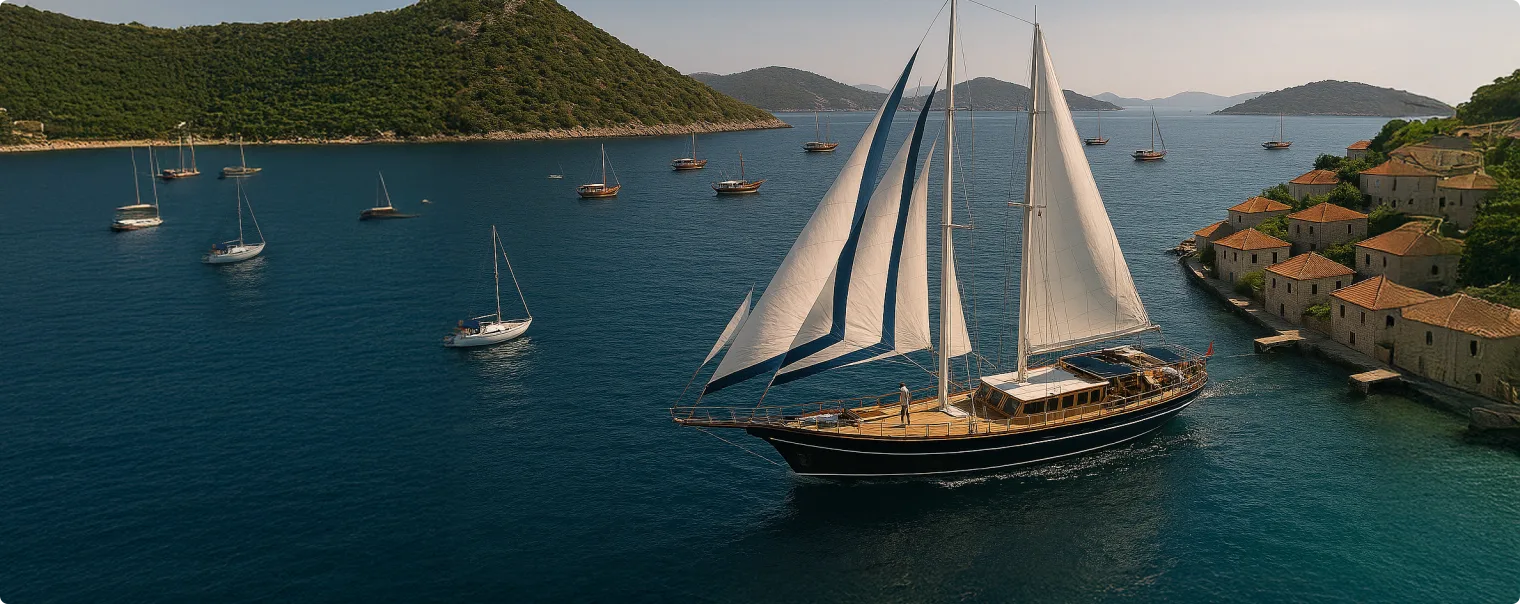
Parikia's own harbour is given over mostly to ferries and commercial traffic, so many gulet cruises in Greece call in here chiefly to let guests explore the old town and its churches on foot before returning to anchor overnight in the calmer bays nearby. Yacht berthing inside the port is limited to a few dozen places, and in a strong meltemi crews generally prefer the northern side of Parikia Bay or the lee behind Cape Agios Fokas. Livadia beach begins a few minutes north of the ferry quay, while Krios and Delfini face the town from across the water and stay quieter. On the waterfront a statue honours Manto Mavrogenous, the heroine of the 1821 war of independence, who spent her final years on Paros and died in Parikia. The bus station and taxi rank both sit by the port, putting Naoussa, the island's other main resort, and the inland village of Lefkes within easy reach; July and August are the busiest weeks, when ferry traffic and room rates peak together.